

Published on 30 July 2026, the bill amends both the Electronic Invoicing Law of 16 May 2019 and the Law of 12 February 1979 related to Value Added tax (“the Luxembourg VAT Law”), marking a decisive step in the Grand Duchy's VAT digitalisation agenda and aligning Luxembourg with the broader EU framework under the VAT in the Digital Age (“ViDA”) Directive. This newsletter sets out the key features of the draft bill and the practical implications for businesses established in Luxembourg.
Key Features of the draft bill
The draft bill introduces the following key changes to Luxembourg's invoicing framework:
- Extended scope: Mandatory e-invoicing moves beyond B2G to cover all domestic B2B taxable transactions between businesses established in Luxembourg.
- Structured format only: For in-scope transactions, an electronic invoice (conforming to the EN 16931 European standard) would need to be issued, transmitted and received in a structured electronic format enabling automatic and electronic processing. Unstructured electronic files, including PDFs, Word documents or image files, would therefore fall outside the proposed definition of an electronic invoice and would not be considered acceptable for e-invoicing purposes. The draft bill expressly provides that no attachment may constitute part of a VAT invoice. All legally required invoice mentions must be included in the structured file itself and may not be contained in accompanying documents.
- Common delivery network: All e-invoices must be exchanged via a single common delivery network meeting nine defined criteria, including the use of open and interoperable electronic invoicing solutions at both national and cross-border level, privacy, data protection and security. The draft bill provides that the common delivery network will be further specified through Luxembourg implementing regulations. Given its established use within the Luxembourg B2G e-invoicing framework since 2022, Peppol appears to be the most likely candidate to serve as common delivery network, although it has not yet been formally designated for domestic B2B transactions.
- ViDA alignment: This draft bill represents Luxembourg's first step towards the implementation of the VAT in the Digital Age (ViDA) reforms, through the introduction of a mandatory domestic B2B e-invoicing framework. Although the bill does not establish Digital Reporting Requirements (DRR), it represents an important step towards the digital reporting environment envisaged under the ViDA package.
Scope: Who Is Affected?
The new legal provisions introduced by the draft bill would apply to domestic B2B transactions where both the supplier and the customer are established in Luxembourg and a VAT invoicing obligation arises under the Luxembourg VAT Law. The current draft provides for certain exclusions, including fully VAT-exempt suppliers and specific categories of transactions. Determining whether a transaction falls within scope will nevertheless require a case-by-case analysis, considering both the VAT profile of the parties and the nature of the underlying supply.
Businesses should therefore map each relevant invoicing flow by considering whether the supplier and customer are both concerned by e-invoicing requirements, whether the supply is treated as taking place in Luxembourg for VAT purposes, whether a Luxembourg VAT invoicing obligation arises, and whether any specific VAT-exemption applies for this transaction.
Nevertheless, despite the current exclusions from the scope of the Luxembourg B2B e-invoicing framework, the draft bill reflects a clear policy direction towards structured e-invoicing becoming the standard format for business invoicing in Luxembourg. More broadly, the proposed measures are consistent with the objectives of the ViDA Directive.
Importantly, the issuance of a compliant electronic invoice would no longer be subject to the recipient’s acceptance, as reflected in the proposed amendment to Article 63 of the Luxembourg VAT Law.
Implementation Timeline
The draft bill adopts a 'receive-first' approach: all in-scope businesses must be capable of receiving and processing compliant e-invoices from 1 January 2028, while the issuance obligation is phased in over 2028–2029 based on business size, with transitional reception alternatives available during the respective deferral periods. The transitional measures should not be viewed as a postponement of the reception obligation. Instead, they are designed to ease implementation by providing temporary compliance options during the migration to the common delivery network.
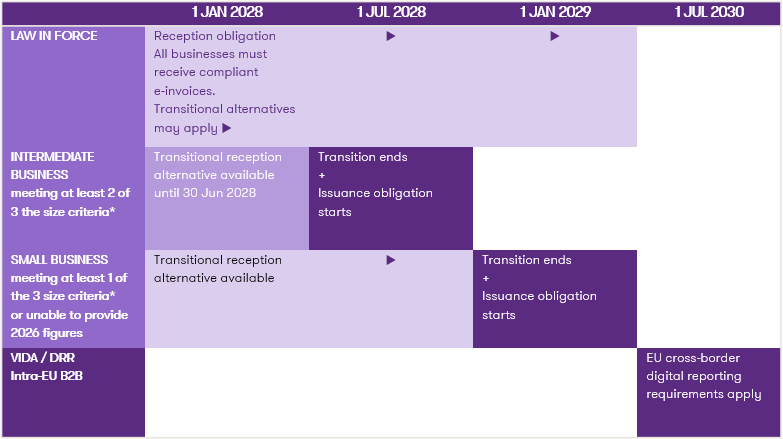
* Size criteria: balance sheet > EUR 7.5M, turnover > EUR 15M, headcount > 50, based on year-end 2026 figures.
Where a recipient or an issuer exceeds the applicable regulatory threshold for the use of alternative technical solutions, a progressive usage fee would apply to e-invoices issued or received above that threshold, as follows:
- EUR 2 excluding VAT per e-invoice for the first 20 invoices above the threshold;
- EUR 3 excluding VAT per e-invoice for the following 30 invoices;
- EUR 4 excluding VAT per e-invoice for the next 50 invoices; and
- EUR 5 excluding VAT per e-invoice for each additional invoice beyond the first 100 invoices.
The same progressive fee mechanism would apply to both compliant e-invoices issued, and compliant e-invoices received.
Technical Framework
The draft bill has clarified the technical definition of an e-invoice and sets out nine criteria for the common delivery network which include the use of open and interoperable electronic invoicing solutions at both national and cross-border level, privacy and data security. The network will be formally specified through Grand-Ducal Regulation. While no formal designation has yet been made, Luxembourg's existing B2G experience suggests that the Peppol network is likely to play a central role in the future domestic e-invoicing framework.
The draft bill provides technical requirements applicable to e-invoices and mentions that they must comply with the EN 16931 European standard. Consequently, PDFs, Word documents or image files would fall outside the proposed definition of an electronic invoice and would not be considered acceptable for e-invoicing purposes. It is intended that all invoicing requirements arising from other legal provisions, such as the Luxembourg VAT law must still be fulfilled and should be contained directly in the e-invoice itself rather than in any accompanying document which will be disregarded for e-invoicing purposes.
Businesses should also not overlook the existing VAT invoicing requirements. The draft bill does not modify the general invoicing rules set out in the Luxembourg VAT Law. Accordingly, invoices must continue to be issued in accordance with the applicable legal requirements and, as a general principle, no later than the 15th day of the month following the one in which the supply is made, or upon receipt of an advance payment, where relevant.
Interaction with Existing VAT Obligations
The introduction of mandatory e-invoicing should not be viewed as a standalone compliance requirement. Businesses will need to assess how the new framework interacts with their broader VAT obligations, invoicing processes and transaction flows.
- VAT-exempt transactions: The obligation applies only to taxable B2B supplies. Fully exempt activities (financial services, insurance, healthcare) are outside scope. Businesses with mixed-activity profiles must carefully map which transaction flows are in scope.
- Credit notes: Documents amending an electronic invoice will generally need to follow the same structured format requirements and clearly reference the original invoice. Businesses should therefore review their existing methodology and adjustment processes to ensure continued compliance.
- ERP and VAT data quality: As structured invoices rely on automated processing, deficiencies in VAT master data, tax determination logic or invoicing workflows may become more visible and generate operational issues. Businesses should assess whether their ERP systems are capable of generating compliant invoice datasets and supporting the required controls.
The Broader EU Context: ViDA
The Luxembourg draft bill should not be viewed as an isolated domestic reform relating to e-invoicing. Rather, it forms part of the broader transformation of the European VAT landscape currently taking place under the VAT in the Digital Age ("ViDA") package. To support this transformation, the European Union adopted the ViDA package through Directive (EU) 2025/516.
The reform is intended to modernise the VAT framework, facilitate compliance for businesses operating cross-border and adapt existing VAT rules to an increasingly digital economic environment.
The ViDA package is generally structured around three core pillars:
- A single VAT registration: The ViDA Directive seeks to reduce the necessity for economic operators to obtain and maintain several VAT registrations across the European Union. To achieve this objective, ViDA expands and enhances existing simplification measures, including the One-Stop Shop ("OSS"), with a view to facilitating cross-border VAT compliance and reducing administrative burdens for businesses operating in several Member States.
- Introduction of Digital Reporting Requirements (“DRR”): E-invoicing developments across the European Union are an important element in the implementation of the DRR framework. From 1 July 2030, certain intra-EU B2B transactions will become subject to structured e-invoicing and digital reporting obligations, contributing to a more standardised and data-driven VAT reporting environment across the European Union. The DRR is also expected to simplify certain compliance obligations, notably through the replacement of the current recapitulative statement (EC Sales List) with a more automated reporting framework.
- Introduction of new VAT measures dedicated to the Platform Economy: This pillar updates the VAT treatment applicable to certain supplies facilitated through digital platforms, particularly in the short-term accommodation and passenger transport sectors, with the objective of ensuring a more consistent VAT treatment across comparable business models.
Among these reforms, the DRR pillar is the most relevant to the Luxembourg draft bill. While ViDA will introduce structured e-invoicing and digital reporting obligations for certain intra-EU transactions from 1 July 2030, the current Luxembourg proposal focuses on an earlier stage of that transition by requiring businesses to exchange invoices in a structured electronic format through a common delivery network, thereby introducing some of the key building blocks of the future ViDA framework.
Although the draft bill does not currently introduce domestic Digital Reporting Requirements, businesses falling within its scope will already be required to adapt their invoicing processes, internal controls, data flows and IT systems to a structured e-invoicing environment. In practical terms, this transition is likely to facilitate future compliance with the broader digital VAT initiatives introduced at EU level, including the Digital Reporting Requirements applicable to certain intra-EU transactions from 1 July 2030.
Our Tax and Technology teams can support you
- Impact assessment: Review of the draft bill's implications for your invoicing processes, IT systems and VAT compliance framework.
- Network readiness: Guidance on delivery network connectivity options, access point selection and technical integration with your existing infrastructure.
- VAT Advisory: Analysis of interactions with your existing VAT position, including VAT compliance requirements, reverse charge, VAT exempt transactions and e-invoicing mapping.
- ViDA readiness: Forward-looking advisory on DRR obligations effective 1 July 2030 and the design of compatible domestic and cross-border e-invoicing infrastructure.
- Training: Tailored sessions for finance, IT and tax compliance teams on the new framework and its operational implications.
How we can help
For further guidance, do not hesitate to reach out to our VAT expert Frank Heykes.
This newsletter is based on the draft law approved by the Luxembourg Government Council on 17 July 2026 and published on 30 July 2026. It is provided for informational purposes only and does not constitute legal or tax advice. The final legislation may differ from the draft described herein. Grant Thornton Luxembourg accepts no liability for decisions taken on the basis of this publication.